 Jev AI
Jev vs Decider-4B: Why the New Leaderboard Lead Needs Context
A practical Jev vs Decider-4B guide to the v2 benchmark result, model versions, decision quality, local deployment, and a fair test in the Jev AI Playground.

Jev vs Decider-4B became a more interesting question when Decider-4B v2 took first place on the September 2026 JevBench board. Jev 1.13.0 moved to second. That sounds decisive until you look at what the score measures. Jev did better on the board's intelligence and calibration axes; Decider-4B was faster and cheaper under the benchmark's setup. A team choosing a model for real decisions needs to understand that split.
Imagine a support inbox with three routes: Billing, Delivery, and Other. A customer writes that a package arrived, but the refund for a missing item never did. Both models can answer a bounded question such as “Which team should handle this first?” and return probabilities for the options. Neither needs to draft a long reply. The real test is whether it picks the right route consistently, knows when a case is uncertain, and fits the way you plan to run it. This Jev vs Decider-4B guide starts there.
What is Decider-4B?
Decider-4B is an independent, open-weight decision model built on Qwen3.5-4B-Base. The Decider project trains it for short, typed answers rather than open-ended chat. You supply context, a question, and allowed answers. Its runtime reads the answer-option scores in one forward pass and turns them into probabilities. The published model card describes roughly 4.2 billion parameters, an English-language focus, a 32k-token context window, and about 8.4 GB for BF16 model weights. Your full serving setup can need more memory than the weights alone.
Decider supports three familiar decision types. Choice selects among named options. Score chooses a point on a defined scale. Noul answers a yes-or-no proposition. That makes it a candidate for routing, labeling, policy checks, and agent steps where software needs a small result it can handle. It does not turn a vague question into a sound policy. If two answer choices overlap, the model may be forced to make an arbitrary-looking distinction.
There is a version detail that matters. The top-ranked system was Decider-4B v2, with a pinned checkpoint and runtime. The project's main model card now describes v2.1 as the current release. Those are different checkpoints. According to the 4B model card, v2.1 changes the balance between hard decision tests and sampled game play. Do not attach v2's JevBench rank to v2.1 without a new evaluation. When someone says “Decider-4B beats Jev,” ask which version and which task they mean.
Jev vs Decider-4B at a glance
| Question | Jev 1.13.0 | Decider-4B v2 |
|---|---|---|
| Who develops it? | TypeSafe AI. | The independent Decider project. |
| How do you run it? | Use a hosted model endpoint. | Run published weights in your own environment. |
| What comes back? | Typed Choice, Score, or Noul decisions with probabilities. | The same broad decision types, produced by its own option-score readout. |
| Published text limit | 64k tokens per request; state plus the longest question is limited to 32k. | The model card lists a 32k-token context window. |
| Hardware responsibility | The provider operates the model. | You provision memory, serving, monitoring, and upgrades. |
| Best initial question | Does a managed service give us enough quality with little setup? | Is local control worth operating a model ourselves? |
| Can you run it in this site's Playground? | Yes, when the Jev service is available. | No; Decider-4B is not connected here. |
The Jev limits come from TypeSafe's model reference. A documented context window is a capacity limit, not a guarantee that either model will notice a crucial sentence buried in a long document. If your case includes pages of policy text, start with the relevant passage and check what happens when you add the rest.
Why did Decider-4B lead the leaderboard?
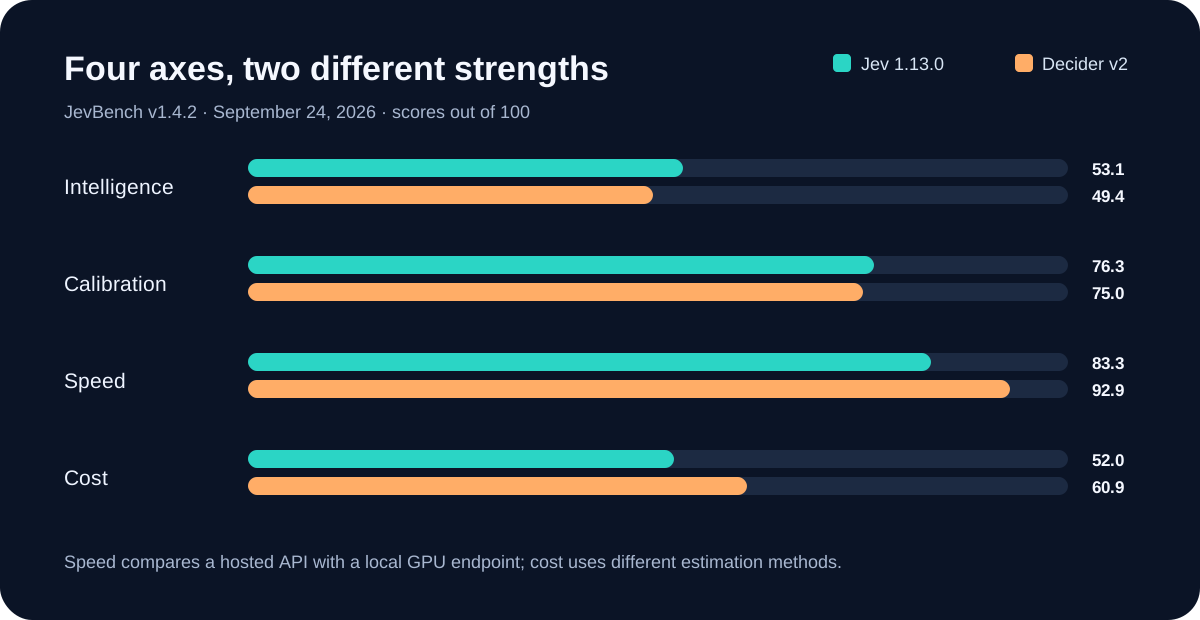
JevBench v1.4.2 scored 534 public and 308 sealed aggregate decisions on September 24, 2026. Its overall number combines four axes with equal weight: intelligence, calibration, speed, and cost. Decider-4B v2 scored 64.1, just above Jev 1.13.0 at 63.3. A lead of 0.8 composite points is real on that scoring rule, but it is a narrow lead on a measure that mixes answer quality with operating characteristics.
The details tell a clearer story. Jev scored 53.1 vs 49.4 on intelligence and 76.3 vs 75.0 on calibration. Decider-4B scored 92.9 vs 83.3 on speed and 60.9 vs 52.0 on the cost axis. Public-question accuracy was 86.6% for Jev and 83.5% for Decider-4B v2. On the difficult sealed set, Jev reached 36.7% and Decider-4B 34.7%. The sealed results are low for both systems, so neither deserves an automatic pass on unfamiliar, high-impact cases.
Speed and price need careful reading. The benchmark measured Decider through an evaluator-owned GPU endpoint, with a 0.02-second median response. It measured Jev through a hosted API, with a 0.65-second median. That is useful information about those two routes, not a clean head-to-head test on identical infrastructure. The board also estimates Decider's cost at about $0.020 per 1,000 decisions using a reference hosted input-token rate; it is not the bill for the GPU used in the test. Jev's roughly $0.040 figure comes from a hosted tariff. A self-hosted deployment still pays for idle GPU time, engineering work, and operations. Your bill will depend on traffic and where the model runs.
The benchmark discloses one more limit: Decider's v2 training included examples generated from the published names of the sealed task families, although the project says it did not read sealed test items. The board accepted the entry, while noting that some private training rows could not be audited for overlap. That does not erase the result. It is a reason to keep your own untouched cases for a final check, especially if your cases resemble a public benchmark category.
Which model fits your workflow?
Choose Jev as a starting point when you want a managed path to structured decisions. You can focus on the question, allowed answers, and quality checks rather than model serving. The published request budget is also larger. A long support history or a policy excerpt may fit more easily, though you should still remove irrelevant text. Jev's stronger accuracy on this benchmark matters most if a wrong answer is more expensive than a few hundred milliseconds of waiting.
Investigate Decider-4B when local operation is a requirement. The weights and runtime are published, so you can pin a version and run it on hardware you control. That can help when your team has an existing GPU environment, wants to inspect implementation details, or needs direct control over upgrades. It also moves responsibility for deployment and performance onto your team. The model card's 8.4 GB BF16 weight size is a planning starting point, not a promise that every laptop will run it comfortably.
Confidence deserves attention either way. A probability beside an answer is not proof that the answer is right. Suppose your refund router chooses Billing with 0.82 confidence. Collect enough labeled cases near that level and see how often Billing was actually correct. Repeat the check for the difficult categories, not only for your average ticket. If the model is confident and wrong on address changes or fraud reports, those cases may need a review rule regardless of its overall score.
Also consider the job itself. A short, English, three-way routing task is close to what both models are designed to do. Asking either model to write a customer apology is a different task; a writing model should handle that after the route is chosen. A 100-category taxonomy, mixed-language inbox, or changing policy is worth its own trial. The leaderboard cannot tell you how your particular labels overlap or whether your users write in the language the model handles best.
A fair Jev vs Decider-4B test you can run
Start with 30 to 50 cases your team has already reviewed. Include ordinary requests, confusing requests, and a few that should go to Other or a human reviewer. Write one question and one set of answer options. Keep the exact wording fixed across the models. Record the correct answer before looking at either output, then note each model's answer, probability, response time, and any failed request. If you change the prompt after seeing a result, set that case aside from your final score.
Look beyond total accuracy. Count the mistakes that matter most: a payment request sent to Delivery, a policy exception treated as a normal case, or a confident answer where the text lacks enough evidence. Inspect the cases where Jev and Decider-4B disagree. Sometimes the fix is clearer option wording. Sometimes one model genuinely handles a hard distinction better. Measure response time from your application, including network and queueing, so the numbers match what your users feel.
You can begin on the Jev AI homepage Playground. Choose Your own case, paste a real but non-sensitive example, and write a Choice, Score, or Yes / No question. Run Jev when the service is available. Then change one important fact in the case and ask the same question again. Does the answer move for a good reason? Save both versions as test cases. The What Is Jev? guide explains the decision types if you are new to them.
The homepage currently runs Jev. To compare Decider-4B, run its pinned v2 release separately with the same cases and include your local hardware and serving costs. This gives you a useful Jev vs Decider-4B decision based on your workflow, rather than assuming a small leaderboard gap settles the issue.
Jev vs Decider-4B FAQ
Is Decider-4B an official Jev model?
No. It is an independent model with a similar typed-decision goal. Its Qwen-based weights and runtime come from the Decider project, while Jev is TypeSafe AI's model.
Is Decider-4B v2 the newest release?
No. The model card describes v2.1 as current. The September 2026 JevBench result is for a pinned v2 checkpoint, so check the exact version before repeating its scores.
Does a higher JevBench score mean better answers?
Not always. JevBench's combined score also rewards speed and cost. In v1.4.2, Jev led on its intelligence and calibration axes and had higher public and sealed accuracy, while Decider-4B v2 led the combined ranking.
Can I try Decider-4B in the Jev AI Playground?
The Playground currently provides Jev, not Decider-4B. Use it to test your Jev question and answer choices, then compare the open model in a separate environment if local deployment is part of your plan.
Keep exploring
 Model Guides
What is Jev-Omni? Learn how this open multimodal decision model handles text, images, audio, and video, how it compares with Jev and Djev, and what to test first.
 Model Comparisons
Compare Djev and Jev for typed AI decisions: text and image inputs, speed, probability quality, deployment, and the right way to test them on your own cases.
 Model Comparisons
A practical Jev vs JevK5 guide covering typed answers, open weights, input limits, published tests, and how to try a real decision in the Jev AI Playground.
 Model Guides
What is Laya AI? Explore its three open-weight decision checkpoints, typed answers, language routing, practical limits, and how it compares with Jev.
Explore Jev AI
See a Jev decision in context.
Open the homepage Playground, compare an example, and turn your own text into a focused question when the live option is available.
Open the Jev AI Playground