 Jev AI
Jev vs Laya: Hosted Precision or Open-Weight Control for AI Decisions?
Jev vs Laya explained: compare typed outputs, open weights, context, benchmark results, and practical trade-offs. Explore Jev decisions in the Jev AI homepage Playground.

Jev vs Laya is a useful comparison because both models aim at a job that chatbots often handle awkwardly: turning text into a bounded decision. Give a model a customer message, a list of teams, and a question such as “Who should receive this?” A decision model returns a typed choice and probabilities rather than drafting a paragraph that software must interpret. Jev and Laya share that broad idea, but they differ in ownership, deployment, context, and measured behavior.
The short answer: Jev is TypeSafe AI's hosted decision model; Laya is a separate open-weight project from Convai Innovations. Neither is a substitute for a writing assistant. Your better choice depends on the task, the number of answer options, the language and length of your input, and whether running a model yourself is a requirement. To understand the Jev side before choosing, open the Jev AI homepage Playground and compare how one question behaves across different examples.
Jev vs Laya at a glance
| Question | Jev | Laya |
|---|---|---|
| Who makes it? | TypeSafe AI develops Jev. | Convai Innovations develops Laya independently. |
| How is it accessed? | A hosted model request through an available provider route. | Open weights and code that teams can run on their own hardware. |
| What does it return? | Typed Choice, Score, and Noul answers with probabilities; Choice and Score include confidence. | Typed choice, score, and yes/no answers with probabilities through a similar request pattern. |
| Can it write prose? | No. It produces decisions about supplied state. | No. It also focuses on decisions rather than free-form text. |
| What input fits? | Textual state; TypeSafe documents up to 64k tokens across a request, with a separate 32k limit for state plus the longest question. | Textual state; the public Laya checkpoints list 512 or 1,024 tokens of context, depending on the checkpoint. |
| Who runs the infrastructure? | The service provider operates the model; your app sends a request. | Your team operates the chosen checkpoint, hardware, dependencies, and upgrades. |
| Is it available on this site? | The Jev AI homepage has preset Jev examples and a live Your own case option when the service is configured. | Laya is discussed here for comparison; the current Jev AI Playground does not run Laya. |
The TypeSafe model reference and the Laya project repository document these differences. The table describes the products as of September 2026; model names, limits, and provider availability can change. “Open weights” means the Laya project publishes checkpoints for local use. It does not mean Jev is a Laya checkpoint or that both models have identical weights.
What do the two models actually decide?
Imagine a message saying, “My renewal was charged twice, and I need the extra payment returned.” For either decision model, you could supply the text as state and ask three small questions: Which team owns the case? Does the customer request a refund? How urgent is the case under a written rubric? Choice handles a fixed set of teams, Noul handles a yes/no condition, and Score handles ordered levels. Your workflow then decides whether to route automatically or request review.
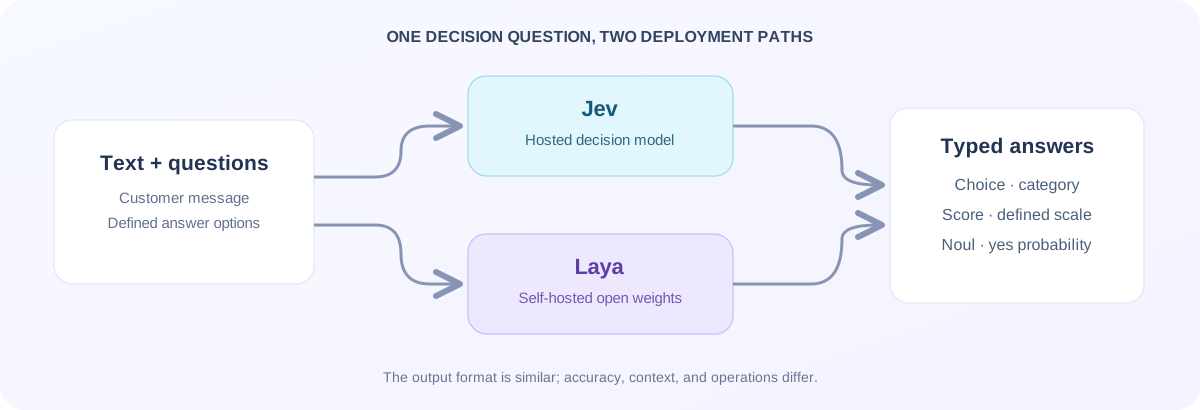
The models' common output shape explains why searches for “Laya Jev” or “Laya vs Jev” often group them together. It does not make their answers interchangeable. Different training, checkpoint choices, token budgets, and question wording can produce different probabilities for the same case. A valid category is also not necessarily the correct category. In a real support queue, include an “Other” option when the available teams may not cover every message, and keep a path for uncertain cases.
Jev's official interface evaluates several questions about a shared state in one request. Laya's project exposes a comparable typed-question design and a Router that chooses among its published checkpoints. For a developer, the important question is whether each model answers your rubric consistently, not whether both accept fields with familiar names. Start with a labeled sample of your own messages before relying on either system.
What do published Jev vs Laya benchmarks show?
A reproducible third-party classifier benchmark tested Jev and Laya on three public datasets, with 500 sampled examples per dataset and shared label descriptions. These are useful observations about those settings, not a universal model ranking. The results below report classification accuracy; higher is better.
| Dataset and answer space | Jev accuracy | Laya accuracy | What the result suggests |
|---|---|---|---|
| AG News, four topics | 84.3% | 90.6% | Laya led on this short topic-classification sample. |
| Banking77, 77 intents | 76.4% | 38.2% | Jev handled this large option set much better in the tested setup. |
| SST-2, two sentiment labels | 95.4% | 92.0% | Both were strong; Jev led by 3.4 points here. |
The benchmark ran Laya locally and reached Jev through a provider, so its latency numbers include different hardware and network paths. It also compared a particular Laya checkpoint and Jev route at a particular time. Public datasets are imperfect stand-ins for private workflows; a few percentage points may not carry over to your own writing style or labels. The result worth remembering is task shape changes the answer. Four labels and 77 labels stress different parts of a decision model.
A separate 751-state head-to-head evaluation likewise found mixed outcomes: Jev led in its curated triage, guardrail, and moderation suites, while Laya led in its AG News and three-way inference suites. That study also measured local Laya and remote Jev, making its end-to-end timing a comparison of deployments as well as models. Read both studies as small, transparent experiments, then test with examples drawn from your own workload.
One more caution matters for readers of the Laya GitHub benchmark tables. The project's stronger typed-decisions score belongs to a checkpoint trained for that benchmark's workflows; its base checkpoints scored near chance there. Laya's own documentation says Jev's cited figures in that table came from other published runs with different prompts. Comparing those columns as if they were one controlled race would overstate the evidence. The independent same-input studies above are more informative for a direct comparison.
When does Jev fit better, and when does Laya fit better?
Choose Jev to evaluate a hosted decision workflow when you want to work with longer textual state, many defined options, or an existing provider connection without operating model weights. That can suit ticket routing with numerous teams, broad article classification, and checks over long policy context. You still need to define the question, review errors, and monitor the version behind an alias. Jev's jev-latest name can move to a newer release; pinning a version can help when you need a fixed evaluation target.
Consider Laya when self-hosting is the requirement. Open weights can matter for local experimentation, infrastructure control, or a system that must run without a hosted model call. Laya publishes English, multilingual, and typed-decisions checkpoints, plus a Router to select between them. That flexibility also creates work: choose the checkpoint, provision compute, account for memory and context limits, test language routing, and own upgrades. “No API fee” is not the same as “no cost”; hardware, engineering time, and monitoring remain.
If you already have thousands of reliable labels for a narrow task, a conventional trained classifier may also be worth testing. If a rule is exact—such as a numeric threshold—ordinary code may be clearer than either AI model. Jev vs Laya is most relevant where the answer must be one of known possibilities, but interpreting varied language is the hard part. For a complete customer reply, a chat model still handles the writing after the decision is made.
Compare the decision pattern on Jev AI
You can explore that pattern on this website without setting up Laya. On the Jev AI homepage Playground, select a scenario such as support tickets, customer feedback, or email priority. Read the input, question wording, allowed answers, and fixed rules. Switch input versions and look at which answers change under the same rule. Those preset comparisons are educational examples; changing a preset does not call a live model.
For your own text, choose Your own case on the homepage, write one focused question, and choose Yes / No, Choice, or Score. When the live Jev service is configured and available, Run Jev submits the case and displays the actual structured response. You can compare that result with your expected label and refine the question. The Jev AI examples guide provides longer walkthroughs, while the What is Jev? guide explains the model's core concepts.
The Jev AI Playground is a place to study and try Jev. It is not a Laya benchmark runner. If you need a rigorous Jev vs Laya decision for a product, build a private test set with the same state, labels, and evaluation rules for both models; record the checkpoint, latency path, accuracy, and cost of mistakes. Keep the website experiment focused on understanding what a useful decision question looks like.
Frequently asked questions
Is Laya the open-source version of Jev?
No. Laya is a separate project with its own checkpoints and maintainers. It follows a similar typed-decision pattern and offers open weights, but it is not TypeSafe's Jev model. The phrase “open-source Jev” can be a shorthand for the interface idea, not a statement about shared weights or official affiliation.
What should I look for on the Laya GitHub page?
The Laya GitHub repository linked above is the primary source for its code, license, checkpoints, Router, and benchmark methods. Check which checkpoint produced any quoted number and whether the result came from a controlled same-input test. A repository can demonstrate reproducibility without proving that a result will hold for your data.
Is Jev always more accurate than Laya?
No. Published comparisons show each model leading on different tasks. Number of choices, input length, language, label descriptions, and Laya checkpoint selection all affect the result. For production decisions, measure errors and uncertainty on your own labeled examples, especially cases where a wrong answer would be costly.
Can I try both models on Jev AI?
The current homepage Playground offers Jev learning examples and a conditional live Jev option. It does not offer Laya inference. You can still use the same example structure as a checklist when evaluating a separate local Laya deployment, and use the Jev AI Playground to make your decision criteria clearer first.
The most useful outcome of a Jev vs Laya comparison is a better test question. Begin with one real classification or yes/no judgment, list the acceptable answers, and decide what an uncertain result should trigger. Then open the Jev AI homepage Playground to see that decision pattern in action.
Keep exploring
 Model Guides
What is Jev? Learn how the Jev AI model turns text into typed decisions, which Jev model names matter, how it compares with chat models, and where to try it on Jev AI.
 Model Guides
What is OpenJev? Learn how this open-source decision server turns a state and typed questions into probabilities, how it differs from Jev, and what to test before using it.
Explore Jev AI
See a Jev decision in context.
Open the homepage Playground, compare an example, and turn your own text into a focused question when the live option is available.
Open the Jev AI Playground