 Jev AI
Djev vs Jev: Image Inputs, Speed, and Decision Confidence
Compare Djev and Jev for typed AI decisions: text and image inputs, speed, probability quality, deployment, and the right way to test them on your own cases.

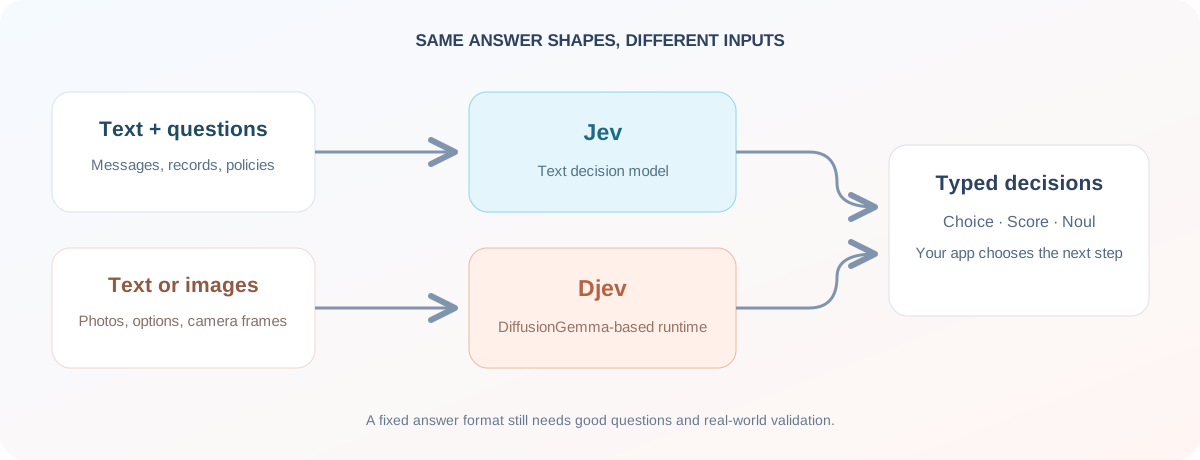
Djev and Jev answer a different kind of question from a chatbot. Instead of writing a paragraph, they choose from answers you define: a team name, an urgency level, or a yes/no judgment. That sounds simple, but it can remove a lot of awkward text parsing from an app. If you searched for “djev AI,” “djev model,” or “jev vs djev,” you probably want to know whether Djev is the same model as Jev, whether it really handles images, and which one is safer to use for a real decision.
Here is the short version. Jev is TypeSafe AI's hosted, text-focused decision model. Djev is a separate DiffusionGemma-based decision system associated with Maisa; its published runtime can also work with images. Both return typed answers, but their model design, input options, speed, and probability quality differ. This guide compares what is documented and what one public benchmark measured. You can try the Jev side with your own text in the Jev AI homepage Playground.
What is Djev, exactly?
Djev is not a new Jev version or a set of TypeSafe weights. The Djev project uses Google's DiffusionGemma checkpoint with a vLLM-based runtime and a layer that turns model output into small, structured decisions. The repository says it does not add newly trained model weights. That distinction matters if you are looking for a “djev model download”: the open project is mainly an inference method and application layer around an existing checkpoint, not a separately trained Djev foundation model.
The public Djev service is presented as a research preview. It accepts text or structured state and can add visual input. A request can ask a Choice question with named options, a Score question with ordered levels, or a Noul question that tests a yes/no statement. The answer contains probabilities over the allowed answers. Djev's API reference describes the formats, limits, and image features. The open runtime has a separate local setup with substantial GPU requirements; a hosted demo and a self-hosted installation are not the same operating environment.
Why use a diffusion model for such a small answer? Instead of generating a full JSON reply one token at a time, Djev puts the possible answer into a compact template and reads the model's scores for the allowed labels. That design helps explain its speed. It does not mean every answer is correct or that its probability is ready to drive an automatic approval rule.
Djev vs Jev at a glance
| Question | Djev | Jev |
|---|---|---|
| Who develops it? | Djev's hosted preview is associated with Maisa; djev-dev publishes an Apache-2.0 runtime over Google's DiffusionGemma weights. | TypeSafe AI develops and serves Jev. |
| What does it return? | Choice, Score, and Noul decisions with probabilities. | Choice, Score, and Noul decisions with probabilities. |
| What can it read? | Text, structured JSON, static images, image options, and sampled camera frames, subject to feature availability. | Text or text-shaped JSON; no native image, audio, or video input. |
| How much input fits? | The current API lists a 32,768-token model context, including image tokens and the answer canvas; other field limits also apply. | Jev 1.13 lists 64k tokens per request and 32k for state plus the longest question. |
| Can you run it yourself? | The open djev-dev runtime can be self-hosted, with demanding reference hardware. | TypeSafe does not publish Jev weights for self-hosting. |
| Can probabilities be used as trusted confidence? | Djev calls its probabilities experimental and uncalibrated; test them on your data first. | Jev is trained for calibrated decisions, but your own task still needs validation. |
| Is it in this site's Playground? | Djev is not currently connected here. | The homepage Playground can run a live Jev case when the service is available. |
The input and context figures come from the Djev API limits and TypeSafe's Jev model reference. Read them as current product limits, not promises about accuracy at the edge of the context window. A long state, many questions, or several images can change both response time and answer quality.
Where does Djev's image support help?
Images are the clearest Djev feature that Jev does not have. Imagine a support team checking photos of damaged products. A Djev request could include the photo and ask whether a seal is visibly broken, or choose which of several pictured parts matches a reference. You can also put images in answer options. According to Djev's documentation, camera mode sends sampled frames as separate image requests; it is not continuous video understanding with memory of earlier frames.
That visual path is useful only when the question is specific. “Is the red warning light on?” is easier to evaluate than “Is this machine safe?” The latter needs context that one picture may not show. For important actions, keep a person in the loop and check the actual error rate for the camera angle, lighting, and object types in your product. Djev's image limits and availability should also be checked at request time, as the API documents feature flags and attachment limits.
Jev works with text. If an image must inform a Jev decision, another tool has to extract the relevant visual facts first, then send those facts as text. That can be a good workflow when you already have reliable OCR or human notes. It is not equivalent to Jev looking at the pixels itself. For purely textual routing, classification, or scoring, the image advantage may be irrelevant.
Is Djev faster, and what do the benchmarks mean?
One useful public comparison is JevBench's published results. On its 534 typed-decision items, the measured median response was 0.24 seconds for Djev and 0.65 seconds for Jev. These were requests to hosted endpoints in that test, not a guarantee for your browser, region, traffic, or image upload. A large photo can add preparation and transfer time before the decision comes back.
Speed is not the whole result. On the benchmark's 220 difficult items, Jev answered 74.1% correctly and Djev 69.5%. Both scored 100% on its 72 easy items. This tells you more than a single leaderboard rank: for straightforward cases, there was little difference, while the ambiguous cases separated the systems. The benchmark later changed its overall scoring method and added fresh sealed items, so always name the version and task set when quoting a rank. Neither version proves which model will work best on your own tickets or photos.
There is also a practical difference between a correct top answer and a meaningful probability. Djev's own documentation says its probabilities are experimental and uncalibrated. If it reports 0.9, you cannot assume nine out of ten similar cases will be right. Jev is designed for calibrated decisions, but even a calibrated model can miss on a new language, category, or domain. Before you use either model to auto-route at a threshold, group real examples by reported probability and count how often each group was correct.
Which model fits a real workflow?
Choose the question before choosing the model. For a text-only help desk, try a few hundred past messages with the same option list and an other category. Check mistakes by topic, not just total accuracy. If the team names overlap, rewrite their descriptions. Jev's longer documented request budget may help when the decision needs a substantial policy excerpt, but the extra text should be relevant to the question.
For a visual quality check, Djev is worth evaluating because it can take an image directly. Build a test set with the same kinds of photos users will upload: blurry shots, poor lighting, missing objects, and look-alike parts. A clean product photo is not a realistic test of a phone camera on a busy warehouse floor. If you plan to self-host Djev, include the GPU and maintenance work in the comparison; the project's reference setup uses an NVIDIA B200-class GPU, Linux, CUDA 13, and BF16 weights.
For either model, keep exact rules in ordinary code. If a refund is allowed only below a fixed amount, code should enforce the amount. Let a decision model interpret the messy sentence that describes the request. An uncertain result can create a review task instead of triggering the next step automatically. A chat model can then draft a reply after the routing decision; neither Djev nor Jev is meant to write the whole customer message.
If you are comparing costs, look beyond a quoted price per token. Count how many inputs each case needs, how often an image must be resized or re-sent, how many questions you ask, and what a wrong decision costs your team. Djev's preview terms may change. Jev has a documented hosted price and versioned model ID, which can make repeatable text evaluations easier to plan. The right answer depends on your traffic and failure cost, not the cheapest number in a comparison table.
Try the decision format on the Jev AI homepage
You can test a text decision here now. Open the Jev AI homepage Playground, select Your own case, paste a short message, and ask a clear Choice, Score, or Yes / No question. Give Choice options distinct descriptions and include other if none may fit. When the Jev service is available, press Run Jev and compare its answer with the one you expected. Change just one fact and run it again to see whether the result changes for the right reason.
The current Playground runs Jev, not Djev. It is still a useful way to prepare a fair comparison: save the same text, question, options, and expected answer, then use that case in a separate Djev evaluation. If your workflow includes photos, note that the homepage text Playground cannot test Djev's image feature. Our What Is Jev? guide explains the three answer types, and the Jev examples show longer workflows.
Common Djev questions
Is Djev an official Jev model?
No. Djev and Jev are separate projects. The similar name and answer types describe a related task, not shared ownership or identical weights.
Is Djev open source?
The djev-dev runtime is published under Apache-2.0 and works with Google's published DiffusionGemma checkpoint. The hosted Djev service has its own preview terms. Check the repository and model licenses if you plan to run it yourself.
Can I trust a Djev probability for automatic decisions?
Not without testing. Djev labels its probabilities experimental and uncalibrated. Measure errors at each probability range on your own examples, then set a review path for uncertain or costly cases.
Can I use Djev on the Jev AI homepage?
The homepage Playground currently runs Jev decisions. Use it to develop a clear text case and compare that case with Djev separately. For an image task, you will need a Djev-capable environment.
Keep exploring
 Model Comparisons
A practical Jev vs JevK5 guide covering typed answers, open weights, input limits, published tests, and how to try a real decision in the Jev AI Playground.
 Model Guides
What is Laya AI? Explore its three open-weight decision checkpoints, typed answers, language routing, practical limits, and how it compares with Jev.
 Model Comparisons
Jev vs Laya explained: compare typed outputs, open weights, context, benchmark results, and practical trade-offs. Explore Jev decisions in the Jev AI homepage Playground.
 Model Guides
What is Jev? Learn how the Jev AI model turns text into typed decisions, which Jev model names matter, how it compares with chat models, and where to try it on Jev AI.
Explore Jev AI
See a Jev decision in context.
Open the homepage Playground, compare an example, and turn your own text into a focused question when the live option is available.
Open the Jev AI Playground