 Jev AI
OpenJev: Open-Source Typed Decisions Without Free-Form Parsing
What is OpenJev? Learn how this open-source decision server turns a state and typed questions into probabilities, how it differs from Jev, and what to test before using it.

Search for OpenJev and you will quickly meet a practical question: can an open model make a small, typed decision without writing a paragraph first? OpenJev addresses that question with a decision server. You provide information to judge, define the permitted answers, and receive probabilities in a structured response. A support team might ask which queue should receive a message; an agent might ask whether a step is complete. The answer is a bounded judgment, not a drafted reply.
Several unrelated experiments use similar names. In this guide, OpenJev means the independent open-source server maintained in the razorback16 OpenJev repository, which uses DiffusionGemma and offers a Jev-compatible request shape. It is not a release of TypeSafe AI's Jev, and a shared API shape does not mean shared weights or identical answers. This distinction matters whenever an “OpenJev model” search result points to a different project.
What is OpenJev?
OpenJev is an open-source server for typed AI decisions. Its main endpoint accepts a state—the text or structured facts to examine—and one or more questions. Each question declares its answer type and criteria. The server returns a yes/no probability, a choice among named options, or a score over an ordered scale. Applications can consume those fields directly instead of extracting a label from a free-form sentence.
The project runs the open-weight DiffusionGemma 26B-A4B model. In OpenJev's decision path, the server prepares answer slots for the allowed options and reads the model's probability distribution at those slots. Its repository describes NVIDIA GPU serving through vLLM and an Apple silicon path through MLX. The code and referenced weights are listed under Apache-2.0 in that project's documentation. These are properties of this particular OpenJev implementation, not of every project that happens to use the name.
The name can also create a second misunderstanding. OpenJev's server exposes a separate text-generation endpoint, but its decision endpoint is designed to answer bounded questions. If the task is to write a customer response, summarize a document, or produce an explanation, a writing model is still the appropriate tool for that output. OpenJev can help decide what to do before another component writes how to say it.
How does the OpenJev model answer a question?
Imagine a customer note: “I was charged twice, and the second charge needs to be refunded today.” First, put that note in the state. Then ask a Choice question with Billing, Technical Support, and Other as allowed queues. A second Noul question can ask whether the customer explicitly requests a refund. A Score question can rate urgency on a written three-level rubric. The same state supports all three judgments.
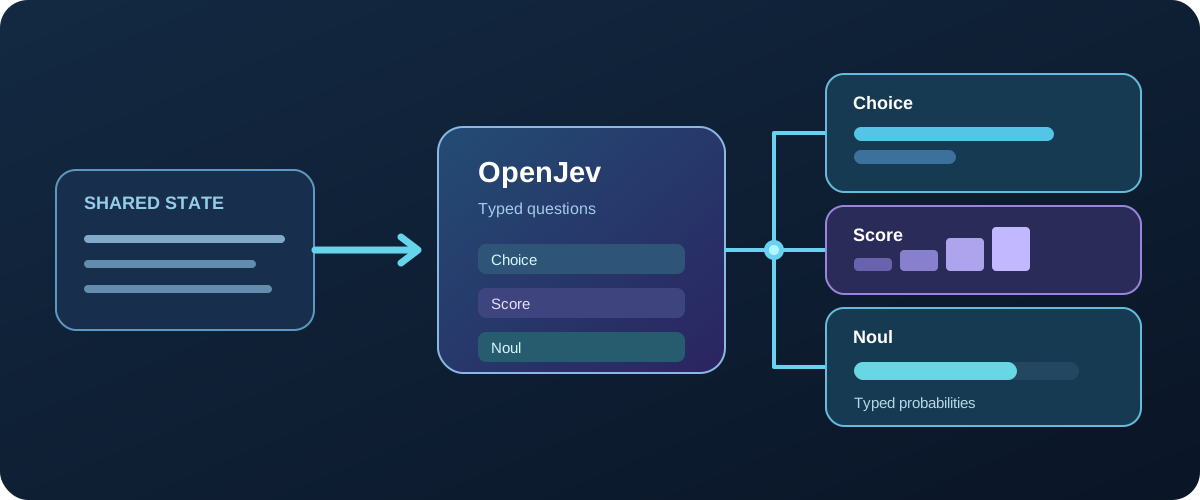
OpenJev's interface uses the same three type names as Jev. Noul is a yes/no probability. Choice reports a selected option and probabilities over the options you supplied. Score reports an ordered result and probabilities over your scale. Choice and Score responses also include a confidence value derived from how concentrated the option distribution is. The result cannot invent a fourth queue if you only supplied three; the application must include an Other or Needs review option when the listed categories may be incomplete.
One distribution is more useful than a bare label, but it needs interpretation. If Billing and Other have similar probabilities, the top label alone may be too weak for automatic routing. OpenJev's confidence calculation summarizes the shape of its distribution; it is not independent proof that a predicted queue is correct. To trust a 0.9 probability as a reliable forecast, measure how often 0.9 predictions are actually right on examples from your own workload. That calibration check is especially important for high-impact decisions.
What are OpenJev's distinctive features?
Open code and deployment control. The OpenJev server and its referenced weights are published for local operation. A team can inspect the implementation, choose hardware, keep a test environment under its control, and measure the effect of upgrades. That control comes with work: model downloads, GPU memory, request limits, observability, and security are now the operator's responsibility.
A defined answer space. OpenJev evaluates only the answer options supplied in a question. This is useful for queue routing, content triage, rubric scoring, and agent decisions where the application needs a known value. It also means a badly designed answer list can produce a confidently expressed but unsuitable choice. Writing clear criteria is part of the product design, not a minor prompt detail.
Multiple judgments on one state. The server can process several questions about the same input. A support workflow can ask for topic, refund intent, and urgency together, then apply its own review rules to the returned values. Keep those questions atomic: “Which team owns this?” is easier to audit than “Decide everything we should do about this customer.”
An adaptable request shape. OpenJev accepts the Jev-style state-and-questions contract, which can reduce the effort of evaluating a second implementation. The project also documents its own model IDs, including a pinned openjev-0.1 and a moving openjev-latest alias. A compatible request format does not guarantee that model IDs, edge cases, latency, or probabilities match Jev. Pin the implementation you tested and record the returned model ID with each experiment.
OpenJev additionally documents image inputs and optional read settings on its server. Those extensions can matter to developers comparing local workflows, but they should be checked against the exact version and backend being used. The core pattern remains simple: one state, explicit questions, and typed answers.
OpenJev vs Jev vs a general chat model
The most useful comparison is the job each system performs and who operates it. Jev is TypeSafe AI's hosted decision model; OpenJev is an independent open-source implementation of a similar interface; a general chat model produces open-ended language. The TypeSafe model reference documents Jev's current text-only input and version names, while the OpenJev repository documents its own deployment and extensions.
| Decision point | OpenJev | Jev | General chat model |
|---|---|---|---|
| Primary output | Typed Noul, Choice, and Score judgments | Typed Noul, Choice, and Score judgments | Generated text; some models can also produce constrained JSON |
| Ownership | Independent open-source server using open weights | TypeSafe AI model served through a hosted API | Depends on the model and provider |
| Deployment | Run the documented NVIDIA or Apple silicon backend yourself, or use a provider | Send requests to the hosted service | Hosted or local, depending on model |
| Input in current documentation | Text and documented image extension | Text only | Depends on model and endpoint |
| Best first use | Evaluate a controlled decision workflow where local operation matters | Evaluate a hosted, purpose-built decision workflow | Draft, explain, converse, or create content |
| Main evaluation risk | Operational load and task-specific answer quality | Service availability and task-specific answer quality | Output validation and whether the answer stays within a fixed schema |
Do not read this table as an accuracy ranking. OpenJev's project publishes latency measurements for its own hardware and settings, but that is not a controlled head-to-head accuracy comparison with Jev. The decision you care about may be a 77-way intent classification, a binary policy check, or a long document review; each stresses a different part of a model. Test both systems with the same inputs, options, and scoring rules before making an application choice.
If you encountered Laya while searching for an open-source Jev alternative, it is another independent project rather than a version of OpenJev. Our Jev vs Laya guide covers that separate comparison. The “open-source Jev” search phrase describes a category of interest; it does not identify one official model family.
Where can OpenJev be useful?
OpenJev fits best when a workflow can state its acceptable answers before inference. For customer support, an application might classify a ticket into a known queue and send ambiguous cases to a person. For content review, it might flag an item for inspection under a stated policy. For an agent, it might choose the next permitted operation from a small list while separate code checks whether the action succeeded. These are decision steps, not entire autonomous workflows.
A good first experiment uses a narrow, measurable question. Assemble real examples with expected answers, include difficult boundary cases, and write down how an uncertain result should be handled. Keep the question wording and options fixed while comparing models. Track errors by category, not only an average score: a false “safe” judgment may cost much more than an extra review. If the rule can be expressed exactly in code, such as “amount exceeds $500,” use code for that rule and reserve a model for the language interpretation around it.
Hardware and operations also affect fit. A self-hosted OpenJev path may suit a team that already runs GPUs and needs control over the environment. It may be a poor shortcut for a small team seeking a zero-maintenance decision API. The repository's speed figures are measurements on specified machines and configurations; they do not promise the same end-to-end response time on a laptop, a busy shared server, or a networked application.
Can you try OpenJev on Jev AI?
The Jev AI homepage Playground currently teaches the typed-decision pattern through Jev examples and a Your own case workspace. Pick a scenario to inspect its input, question, criteria, and result. Change the example input to see which judgments change under the same rules. Those preset examples are educational content; switching between them does not invoke a live model.
To test your own text on this website, open the homepage Playground, choose Your own case, enter a focused question, and select Yes / No, Choice, or Score. When the live Jev service is configured and available, Run Jev submits that case and shows Jev's structured answer. The current Playground does not run OpenJev, so a result here must not be described as an OpenJev benchmark. Use it to refine a decision question you can later evaluate against a separate OpenJev setup.
That distinction is helpful for readers looking for “OpenJev online.” You can learn the interface and try the decision workflow on Jev AI without assuming two independent models are interchangeable. The What Is Jev? guide explains the hosted model and its version aliases in more detail. Start with a concrete question on our homepage, then compare model implementations only after the question itself is clear.
Frequently asked questions about OpenJev
Is OpenJev the open-source version of Jev?
No. OpenJev is an independent project that follows a Jev-compatible request shape. TypeSafe's Jev and this OpenJev implementation have different ownership, weights, deployment paths, and model identifiers. Similar output types are useful for evaluation, but they do not make the models equivalent.
Is OpenJev a chatbot?
Its main decision endpoint is for typed judgments rather than conversation. The same server documents a separate text-generation endpoint using its base model. Choose the endpoint that matches the job; a decision probability is not a finished explanation or customer-facing reply.
Does OpenJev need training for each new category list?
The described API puts criteria and options in the request, so you can change the question without training a new classifier for every list. That flexibility does not guarantee accuracy on a new domain. Evaluate it with examples from the domain before automating a consequential action.
Can OpenJev and Jev return different answers to the same question?
Yes. A shared request format specifies how to ask, not what each model will believe. Different models, versions, read settings, and hosting conditions can change probabilities. Preserve the exact question and criteria during comparisons, and log which model and version produced each answer.
Where should I start if I am new to decision models?
Start with one real message and one answerable question. Define the permitted options and what an uncertain answer should trigger. Then open the Jev AI homepage Playground to see that question structure in action. Once your evaluation set is ready, an OpenJev deployment becomes something you can measure rather than a name to guess from.
Keep exploring
 Model Comparisons
Jev vs Laya explained: compare typed outputs, open weights, context, benchmark results, and practical trade-offs. Explore Jev decisions in the Jev AI homepage Playground.
 Model Guides
What is Jev? Learn how the Jev AI model turns text into typed decisions, which Jev model names matter, how it compares with chat models, and where to try it on Jev AI.
Explore Jev AI
See a Jev decision in context.
Open the homepage Playground, compare an example, and turn your own text into a focused question when the live option is available.
Open the Jev AI Playground